By Dr. Bob Uttl
School District No. 5 (SD5) leadership—including the Board of Education/Trustees, the Superintendent, and the Human Resources Department—claims to treat all employees equally and to make employment decisions without regard to age, sex, race/ethnicity, medical diagnosis, or other protected characteristics.
Those claims are contradicted by SD5’s own actions.
Under oath, Mr. Brent Reimer, Director of Human Resources (2011–present), and Ms. Cynthia Stuart, former Director of Human Resources (2008-2011), testified that SD5 does not consider or rely on age, sex, race/ethnicity, medical diagnosis, or other prohibited factors in employment decisions, including fitness-for-duty assessments. Both categorically denied treating employees differently based on these characteristics. They further acknowledged that the Collective Agreement expressly prohibits discrimination, testified that they were familiar with its terms, and affirmed that compliance with the agreement is mandatory (see excerpts from their testimony below).
Despite this sworn testimony, SD5 implemented and relied upon an fitness-for-duty assessment process that is discriminatory by design.
SD5 delegated responsibility for defining the minimum performance standards for Ms. T’s position to two clinical psychologists, Dr. Mary Westcott and Dr. John Braxton Suffield. Rather than establishing objective, job-related minimum standards based on absolute levels of competence or functional capacity, both psychologists employed percentile-based, group-specific, criteria based on performance of specific groups defined by examinees’ age, sex, race/ethnicity, and/or other demographic variables.
SD5 hired psychologists’ approach guarantees unequal treatment of different age, sex, race/ethnicity, etc. groups. Because performance on many psychological tests varies systematically across demographic groups, a percentile-based, group-normed framework necessarily imposes different absolute performance thresholds/cut off scores on individuals solely because they belong to different protected classes. In effect, employees of different ages, sexes, or racial and ethnic backgrounds are held to different performance standards while those standards are deceptively labeled as the same “minimum” requirement.
SD5 knowingly adopted these discriminatory standards, relied upon opinions generated by them, and used those opinions to judge Ms. T’s fitness for duty. At no point did SD5 leadership question whether it was lawful—or even rational—to require different levels of actual ability from different employees based solely on protected characteristics. This failure cannot be dismissed as oversight; it reflects a fundamental abdication of responsibility by SD5’s senior leadership charged with ensuring compliance with human rights obligations.
The hypocrisy of SD5’s position is stark. Ms. Cynthia Stuart and Mr. Brent Reimer both have professional experience evaluating student performance. They would presumably never adjust academic expectations/standards upward or downward based on whether a student was male or female, younger or older within a cohort, or White, Black, Indigenous, or otherwise racialized. Yet SD5 applied precisely this kind of differential standard to a professional employee — Ms. T — over 15 years ago and keeps defending it as legitimate ever since.
Applying demographic-based performance thresholds to an employee—while denying under oath that such factors are considered—constitutes discrimination by SD5, regardless of how SD5 framed it procedurally, whether or not they outsourced the discrimination to two hired psychologists. SD5’s conduct demonstrates not equal treatment, but a profound misunderstanding—or willful disregard—of the most basic principles of fairness, and non-discrimination.
Let’s examine the details of SD5 hired psychologists’ age, sex, race/ethnicity, education, etc. simple and advanced discrimination methods.
Norm vs. Criterion Referenced Testing
Norm-referenced testing measures an examinee;’s performance relative to a group of peers (the “norm” group). It asnwers: “How does this examinee compare to others?” Test scores rank individuals (.e.g, percentiles) within the distribution of the examinee’s peers. Norm referenced testing is inherently comparative,. Obviously, the norm-referenced testing does not (and cannot) answer the question whether or not the examineee passed the set standard because the standard was not set, not predetermined.
Because performance on many psychological tests including intelligence tests, memory tests, personality tests, motor tests, etc. vary with age, sex, race/ethnicity, education, etc., psychologists sometimes use age, sex, race/ethnicity, education, etc. specific norms (e.g., age norms, race norms, sex norms) when the question is: “How does this examinee compare to others of the same age, sex, race/ethnicity, education, etc.?”
In contrast, criterion referenced testing measures an examinee’s performance against a fixed, predetermined standard (the “criterion”). It answers: “Has this examinee passed the set standard? The examinee’s score is absolute and not influenced, not dependent on how other examinees performed. Every student could pass (or fail) if they meet (or don’t meet) the standard.
Examples of criterion-referenced testing are:
- University course grades: Many universities publish standards for letter grades. For example, in many universities, a student must obtain 85% or higher grade to get a letter grade of “A” (e.g., University of Calgary Grades system)
- A driver’s license knowledge test: For example, in Alberta, Canada, an examinee passes if they get 25 out of 30 multiple choice questions correct. The question is: Does this examinee has sufficient knowledge to drive safely? (Alberta Driver’s Knowledge Test)
- Professional exams like nursing licencing exams (NCLEX): On NCLEX-RN passing score is 0.00 Logits whereas on NCLEX-PN passing score is -.18 Logit. The question is: Does this examinee has sufficient knowledge and skills to enter the profession and practice nursing at entry level? (NCLEX Passing Standard)
- Government of Canada’s General Intelligence Test (GIT-310): The pass mark is 68 out of 121 multiple-choice questions. If an examinee, passes, they can use the result as an alternative to a univerity education requirements. The questions is: Does this examinee have sufficient intelligence to qualify for jobs requiring university degrees?
Criterion referenced tests used in high stakes decisions, including all of the tests above, do not have different passing marks for examinees of different ages, sexes, races/ethnicities, etc. because (a) it would make no sense, and (b) it is illegal (at least in Canada, USA, and many other Western countries). Obviously, if some ability is required for doing something, the required ability does not change with, for example, skin color of a person doing it.
SD5 leadership — including Mr. Brent Reimer and Ms. Cynthia Stuart — ought to be familiar with both (a) the concept of criterion referenced testing and (b) their obligation to treat individuals (including students and teachers) equally regardless of their age, sex, race/ethnicity, etc.. BC Ministry of Education and Child Care imposes criterion referenced standards for assigning Letter Grades to students, with the standard for each letter grade defined “in relation to learning outcomes for the course” and not by student’s position relative to other students. And obviously, these standards are the same for all students regardless of their age, sex, race, etc.
| Letter Grade | Percentage Grade (courses numbered 10, 11, 22) | Grading Standard (“in relation to learning outcomes for the course”) |
| A | 86-100 | The student demonstrates excellent or outstanding performance in relation to learning outcomes for the course. |
| B | 73-85 | The student demonstrates very good performance in relation to learning outcomes for the course. |
| C+ | 67-72 | The student demonstrates good performance in relation to learning outcomes for the course. |
| C | 60-66 | The student demonstrates satisfactory performance in relation to learning outcomes for the course. |
| C- | 50-59 | The student demonstrates minimally acceptable performance in relation to learning outcomes for the course. |
| F | 0-49 | (Failing) The student is not demonstrating minimally acceptable learning in relation to the learning outcomes for the course. The letter grade “F” may only be assigned if an “IE” (Insufficient Evidence of Learning) letter grade has previously been assigned for that course. |
SD5 leadership ought to also understand that they cannot have different standards for their employees depending on the employees’ age, sex, race/ethnicity, etc. just like they do not have different standard of performance depending on whether a student is relatively younger or older within his class; male or female; is Asian, White, Hispanic or Black; etc..
Fitness For Duty Assessments Are Fundamentally Criterion Referenced
Fitness for duty (FFD) assessments are fundamentally criterion-referenced. The core purpose of FFD assessments is to determine if an individual meets a fixed, predetermined standard of capability to safely and effectively perform the essential functions of their specific job. In FFD assessments, an examinee’s performance is judged against an absolute criterion and not relative to how others perform.
Quite obviously, the fixed, predetermined standards to perform the essential functions of Ms. T’s specific job has to be established by Ms. T’s employer, SD5, and cannot be outsourced to a mail man or a psychologist as neither the mail man nor the psychologist have necessary expertise nor authority to establish the minimum standards of Ms. T’s job in SD5.
Mr. Brent Reimer, Director of Human Resources, and Ms. Cynthia Stuart, a former Director of Human Resources, testified under oath that SD5 did not establish any fixed, predermined standards for Ms. T’s job. They also testified that they did not provide any standards for Ms. T’s job to any psychologists, including Dr. Mary Westcott and Dr. John Braxton Suffield. Obviously, they could not provide such standards because SD5 never established them. In fact, both Mr. Brent Reimer and Ms. Cynthia Stuart testified that they did not even provide these psychologists with Ms. T’s job description.
Both Dr. Mary Westcott and Dr. John Braxton Suffield also testified under oath that they never received any standards whatsoever from SD5 and that they never received any job description for Ms. T’s job. This is of course not surprising given that (a) both Mr. Brent Reimeer and Ms. Cynthia Stuart testified that SD5 did not have them, (b) SD5 did not disclose them to Ms. T in 2016, and (c) SD5 did not disclose them under their disclosure obligations in an ongoing litigation.
Both psychologists — Dr. Mary Westcott and Dr. John Braxton Suffield — decided:
- to use norm-referenced testing
- to use age, sex, race/ethnicity, and/o education specific norms (age norms, sex norms, race norms, education norms, and their combinations)
- to set the “standard” at 16th percentile but sometimes at some other percentile, for example, 33rd percentile
In effect, these psychologists concluded that 16% to 33% of all workers presently working in any occupation are not fit for duty, including 16% to 33% of SD5 teachers currently employed by SD5, 16% to 33% of principals employed by SD5, 16% to 33% of SD5 Trustees, 16% to 33% of airline pilots, etc. If this sounds irrational, it is.
Employment Discrimination Is Inevitable Consequence Of Using Norm-Referenced Testing In Fitness For Duty (FFD) Assessments
Using norm referenced testing and comparing examinees to their age, sex, race/ethnicity, and/or education specific group norms inevitably and automatically results in different FFD opinions and decisions for individuals with exactly the same abilities of interest but different age, sex, skin color, years of education, etc.. Dr. Mary Westcott used mostly normed referenced testing with age specific norms but also some age, sex, race, and education specific norms. Dr. John Braxton Suffield used mostly normed referenced testing with age, sex, race/ethnicity, and education specific norms. Hence, Dr. Mary Westcott and Dr. John Braxton Suffield’s FFD opinions were inevitably discriminatory, and based on factors that SD5 could not consider.
Although both Ms. Cynthia Stuart and Mr. Brent Reimer understood that both Dr. Mary Westcott and Dr. John Braxton Suffield were comparing Ms. T to age, sex, race, and/or education specific standards, they did not question it and blindly accepted the FFD judgments of their hired professionals. Neither Ms. Stuart nor Mr. Reimer asked Dr. Westcott and Dr. Suffield why they were comparing Ms. T to specific age, sex, race, and/or education groups. Neither sought assistance of independent expert to help them understand what Dr. Westcott and Dr. Suffield were doing.
In FFD Assessments, Age Norm Referenced Testing Holds Different Age Groups To Different Standards
One of the well established scientific fact, discussed in all introductory psychology textbook, is that there is substantial decline in processing speed with aging across adult lifespan. These declines are observed on many WAIS-IV CDN subtests as well as on many other tests that were administered to Ms. T.
Dr. Mary Westcott used age norms, for example, WAIS-IV CDN (Wechsler, 2008) IQ age norms, and compared Ms. T’s IQ to the IQs of the same-aged people in the normative samples. In doing so, Dr. Mary Westcott was using different minimum intelligence and other ability standards for Ms. T than for examinees of other ages. In other words, Dr. Mary Westcott’s methodology directly discriminates against younger examinees because younger examinees must demonstrate much higher intelligence and much higher abilities than older examinees to place in the same relative position to other examinees of the same age.
As an example, the figure below shows the performance on WAIS-IV (2008) reasoning and speed tests for younger (20-24 years old) vs. older (65-69 years old) adults in the US normative sample. Using the 16 percentile (corresponding to IQ of 85) within group standard as an example, examinees of different ages have to have widely different ability levels to pass this standard: Older adults need to have only about 69 IQ points whereas Younger adults have to have at least 85 IQ points in the distribution defined/referenced by the distribution of younger adults. Thus, Dr. Mary Westcott’s simple, age based discrimination method sets up different standards for elementary school teachers depending on teachers’ age.
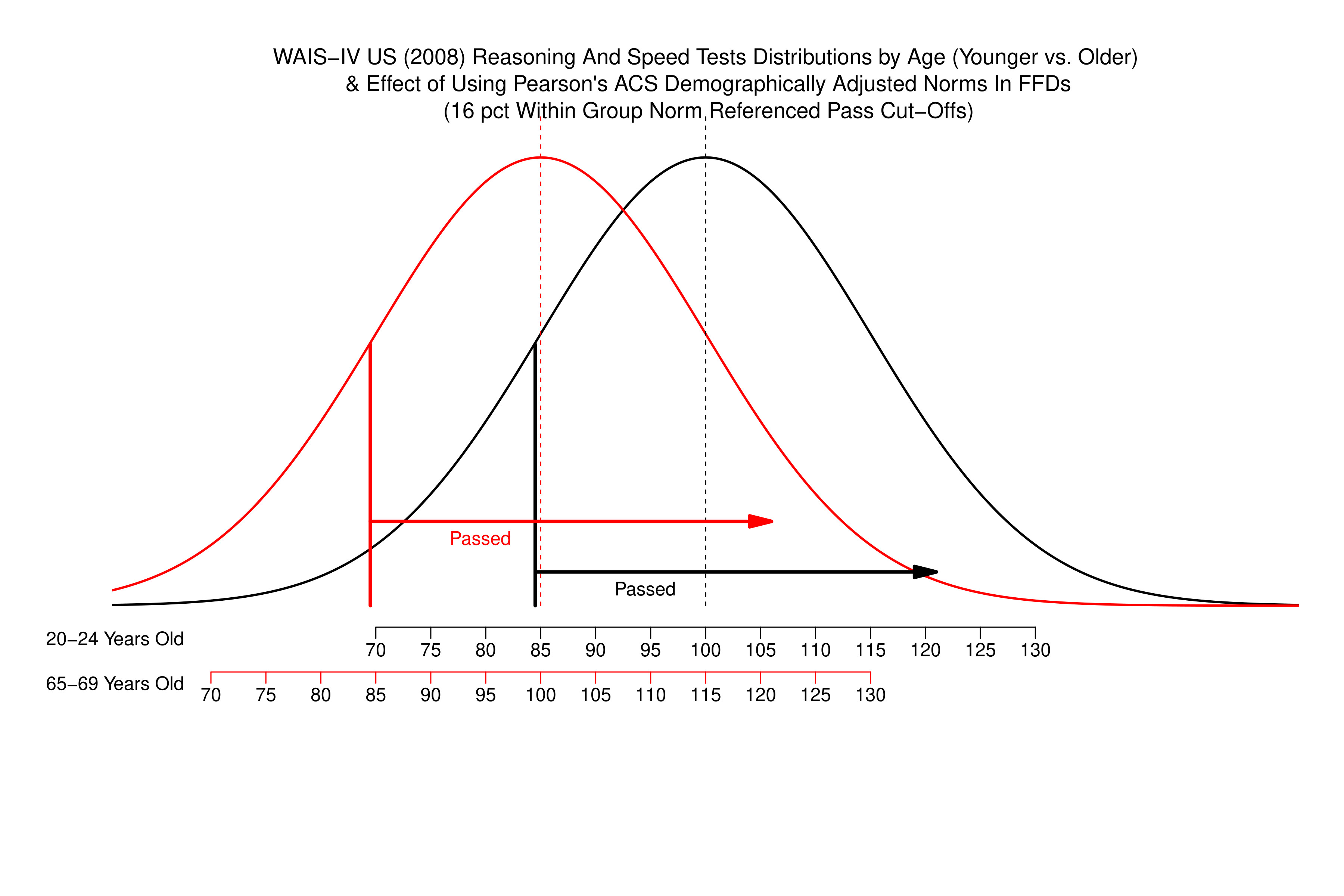
If examinees’ performance had anything to do at all with their ability to perform their teaching duties, for example, not losing kids on field trips, Dr. Mary Westcott’s view is that younger teachers must not lose kids on field trips whereas older teachers can do so on regular basis because Dr. Westcott requires far lower minimum (absolute) ability standards for older than for younger teachers due to her age based discrimination methodology, that is, her use of within age group standards.
Both Ms. Cynthia Stuart and Mr. Brent Reimer adopted Dr. Mary Westcott simple discrimination methods, never questioned it, never asked Dr. Westcott to explain it to them, and never asked any other psychologists to explain it to them. Both Ms. Cynthia Stuart and Mr. Brent Reimer testified that they completely trusted their hired professionals: Dr. Mary Westcott and Dr. John Braxton Suffield (see excerpts of Mr Brent Reimer’s and Ms. Cynthia Stuart’s testimony below).
SD5 simply adopted Dr. Mary Westcott discrimination methods and refused Ms. T attempts return to work.
In FFD Assessments, Race Norm Referenced Testing Holds Different Races To Different Standards
Dr. John Braxton Suffield criticized Dr. Mary Westcott use of a “simple” discrimination method, that is, Dr. Westcott comparing Ms. T to age-specific norms only, and decided to use a more “advanced” discrimination method and compared Ms. T scores on WAIS-IV CDN to age, sex, race, and education specific norms published by Pearson: Advanced Clinical Solutions for WAIS-IV (ACS for WAIS-IV US). When used in fitness for duty assessments and other employment assessments, ACS for WAIS-IV demographically adjusted norms for age, sex, race/ethnicity and education automatically and inevitably leads to age, sex, race/ethnicity and education discrimination. As an aside, Dr. John Braxton Suffield’s use of these norms also completely ignored that the ACS for WAIS-IV US norms were never validated with Canadians, were not applicable, and their use amounted to junk science practice by Dr. John Braxton Suffield.
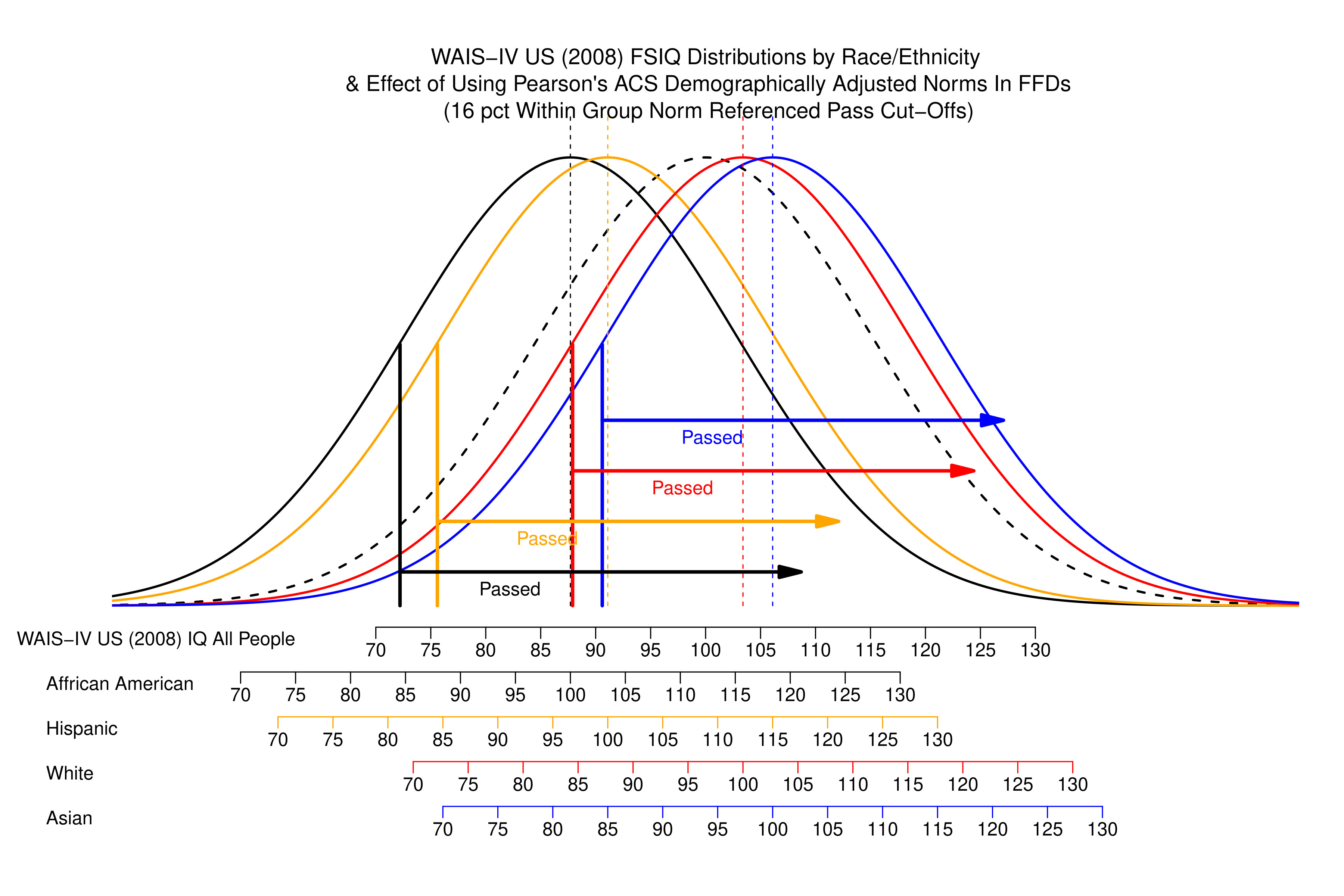
Holdnack, Drozdick, Weiss, and Iverson (2013) (available on amazon.ca and elsewhere) published race/ethnicity norms for WAIS-IV US in Table 4.8 (p. 190). WAIS-IV US (2008) average FSIQ by race/ethnicity listed in Holdnack et al. is: African-American: 87.7, Hispanic 91.1, White: 103.4, and Asian: 106.1. Accordingly, Figure below shows this WAIS-IV US performance by race/ethnicity graphically. The dashed black line shows the IQ distribution of the US normative sample as a whole, that is, of all people included in the normative sample (M = 100, SD =15). The solid lines show the IQ distribution of the four race/ethnicity groups relative to the WAIS-IV US IQ norms for the entire normative sample, that is, all people. As noted above, African American’s mean IQ was 87.7, Hispanic’s mean IQ was 91.1, White’s IQ was 103.4 and Asian’s IQ was 106.1, that is, the groups differ substantially in terms of their mean IQ or general mental ability as assessed by WAIS-IV US. Within race/ethnicity group IQ scales are printed below the IQ scale for the entire normative sample, or all people.
For this particular test, Dr. John Braxton Suffield completely arbitrarily chose within race/ethnicity group 16th percentile as the “standard” or “cut-off” for “impairment”, corresponding to withing race/ethnicity group FSIQ of 85. The IQ of 85, within each race/ethnicity group, is denoted by vertical solid lines. The automatic and inevitable result of Dr. John Braxton Suffield’s choices is that to pass Dr. Suffield “arbitrary 16th percentile within group standard”, individuals from different races had to have widely different levels of ability: Asian examinees had to have FSIQ of at least 92 (in distribution of all people, all race/ethnicities combined) to pass Dr. John Braxton Suffield’s arbitrary standard whereas African American’s had to have FSIQ of only about 83 (in distribution of all people). Thus, Dr. John Braxton Suffield’s advanced discrimination method setup different standards for elementary school teachers depending on specific teacher’s age, sex, race/ethnicity and education.
Both Ms. Cynthia Stuart and Mr. Brent Reimer adopted Dr. John Braxton Suffield’s advanced discrimination methods, never questioned it, never asked Dr. Suffield to explain it to them, and never asked any other psychologists to explain it to them (see below). Both Ms. Cynthia Stuart and Mr. Brent Reimer testified that they completely trusted the professions (see below).
SD5 simply adopted age, sex, race/ethnicity, education, etc. discrimination methods and discriminatory opinions of their hired psychologists as their own. As the result, SD5 refused Ms. T’s attempts to return to work and eventually terminated her employment.
Conclusion
Mr. Brent Reimer, Director of Human Resources for SD5, has attended all hearings to date (39 days) in his capacity as the instructing client, providing direction to SD5’s legal counsels from Harris & Company. It appears that Mr. Reimer has not yet recognized that the opinions and conclusions of psychologists retained by SD5 lack validity and are inherently discriminatory. These opinions rely on norm-referenced testing, arbitrary standards developed by retained psychologists, and age-, sex-, race/ethnicity-, and education-based norms—criteria that SD5 is legally prohibited from using in employment decision-making.
Like the retained psychologists, Mr. Reimer also appears not to appreciate that SD5 operates in British Columbia, Canada, and that norms developed in the United States have no demonstrated reliability or validity for use in a Canadian context. In fact, Longman et al. (2007) and others demonstrated that US norms were invalid for use with Canadians.
The SD5 superintendent and Trustees may be similarly ignorant. SD5 is spending millions of dollars in public funds to defend the untenable position that a Canadian woman of average intelligence and cognitive functioning is “prevented” from performing the duties of an elementary school teacher. Alternatively, the Superintendent and Trustees may be fully aware of these issues yet continue to use and support discriminatory practices based on age, sex, race/ethnicity, or education—despite being legally prohibited from discriminating against employees on such grounds, including age, sex, race/ethnicity, medical condition, or political beliefs.
Wittingly or unwittingly, SD5 has joined a number of organizations that have relied on age-, sex-, race-, or education-based norms to treat individuals differently based on their group membership, including the NFL (read here & here) and College of Alberta Psychologists.
Appendix:
Excerpts From Ms. Cynthia Stuart and Mr. Brent Reimer’s Under Oath Testimony
Ms. Cynthia Stuart’s Testimony
Ms. Cynthia Stuart Testified That SD5 Treats All Teachers Equally
Ms. Cynthia Stuart testified under oath that SD5 cannot hold teachers to different standards depending on their age, sex, race/ethnicity, etc..
QUESTION: Now, when you were the Director of Human Resources, did School District 5 held younger teachers to higher standards than older teachers when using this Article 16 to evaluate teachers?
CYNTHIA STUART: Is that a question?
QUESTION: Yes.
CYNTHIA STUART: Are you asking if we held younger teachers and older teachers to different standards?
QUESTION: Yes.
CYNTHIA STUART: Absolutely not.
QUESTION: And when evaluating these teachers, according to Article E16, did you hold women versus men teachers to different standards?
CYNTHIA STUART: Absolutely not.
QUESTION: And when using this Article 16, did you hold Asian teachers to higher standards than white teachers?
CYNTHIA STUART: Absolutely not.
QUESTION: Did you hold any race or ethnicity to different standards than any other race or ethnicity?
CYNTHIA STUART: Absolutely not.
QUESTION: And did you hold teachers with 17 years of education or with master’s degrees to different standards than teachers with bachelor’s of education degrees?
CYNTHIA STUART: Absolutely not.
QUESTION: So, when you were the Director of Human Resources, School District 5 held all teachers to the same standard regardless of age, sex, race, ethnicity, education, medical diagnosis, disability. Correct?
CYNTHIA STUART: Absolutely. The collective agreement applies, to all parties.
QUESTION: So in fact, it would be contrary to your own policies to hold teachers to different standards of teaching depending on age, sex, race, ethnicity, education, medical diagnosis, disability, etc., correct?
CYNTHIA STUART: As stated in the collective agreement, all are treated equal.
Cross-Examination of Cynthia Stuart
Ms. Cynthia Stuart understood that SD5 cannot demand, for example, different attention ability levels from teachers, for example, teachers of different ages.
QUESTION: So the attention, according to you, is important for performing one’s teaching duties, correct?
CYNTHIA STUART: As I said, attention is a necessary attribute.
QUESTION: Okay. And in order to decide whether a teacher has enough attention to perform their teaching duties, you cannot have a different standard for teachers of different ages, sexes, races, education, disability, medical diagnosis, correct?
CYNTHIA STUART: I have no idea what you just asked me.
QUESTION: Well, I’m asking you whether you can demand different attention ability level from teachers of, let’s say, different ages.
CYNTHIA STUART: No.
Cross-Examination of Cynthia Stuart
Ms. Cynthia Stuart Testified That Article E17 “No Discrimination” Also Applies To Fitness For Duty Assessments
Ms. Cynthia Stuart also agreed that the Collective Agreement Article A17 No Discrimination also applies to fitness for duty assessments, that is, whether a teacher can continue in their teaching duties. However, Ms. Cynthia Stuart testified that SD5 did not “consider IQ points.”
QUESTION: And so it [Article E17] also applies to, uh, determining the fitness for duty assessments, correct?
CYNTHIA STUART: I do not agree with that statement.
QUESTION: Is it, uh, your understanding that you can use, uh, different standards for determining which teacher can continue working depending on a teacher’s race?
CYNTHIA STUART: No. The standards are consistent throughout the district.
QUESTION: So when you are trying to determine whether the teacher teacher can continue in the teacher’s duties, the standards must be the same regardless of the race, sex, age, disability, diagnosis of the teacher, correct?
CYNTHIA STUART: Those attributes are not considered.
QUESTION: Correct, and so they must be, the standard must be the same, correct?
CYNTHIA STUART: The standard is the same for all employees of school district number five.
QUESTION: And that standard is the same including when you are trying to determine whether the teacher still has enough attention, enough memory, enough IQ points to continue in teaching duties, correct?
CYNTHIA STUART: No, not correct. We do not consider IQ points. And that is not part of the no discrimination clause.
Cross-Examination of Cynthia Stuart
Ms. Cynthia Stuart was taken to Article E17 “No Discrimination” and agreed that SD5 cannot discriminate against teachers “on the basis of race, color, creed, age, physical handicap,…”
QUESTION: Yeah. I have Article E17 No discrimination.
CYNTHIA STUART: Yes.
QUESTION: And it states, and you testified before that was in fact the case but I will read the article for you So the Board and Association agree that there will be no discrimination against any member of the bargaining unit on the basis of race, color, creed, age, physical handicap, sex or sexual orientation, religious or political affiliation, national origin, marital status, whether he she has children or because he she is participating in the activities of the Association, carrying out duties as a representative of the Association or involved in any procedure to interpret or enforce the provision of the agreement. Do you agree with that?
CYNTHIA STUART: That is what’s printed and that is what has been agreed to by both the Union and the Association.
Cross-Examination of Cynthia Stuart
Ms. Cynthia Stuart Understood That Dr. Mary Westcott Compared Ms. T To People Of Her Age
Ms. Cynthia Stuart was taken to Dr. Mary Westcott September 15, 2010 Report and agreed that Dr. Mary Westcott, hired by SD5, used intelligence test to assess Ms. T. However, Ms. Stuart testified that SD5 did not consider Ms. T’s number of IQ points even though Dr. Westcott did and even though SD5 relied on Dr. Westcott’s opinions.
QUESTION: Do you recall receiving this report from Dr. Mary Westcott with Mandel & Associates on Ms. T?
CYNTHIA STUART: I would have received it, yes.
QUESTION: If you can scroll a little bit down into Test Administered. Thank you.
QUESTION: Now, do you see fourth item from the bottom? So, the bottom one is Wide Range Achievement Test, then there’s a Wechsler Test of Adult Reading, then there’s a Wechsler Memory Scale, and there’s a Wechsler Adult Intelligence Scale. So, Dr. Westcott administered Intelligence Scale to Ms. T, correct?
CYNTHIA STUART: That’s the test she’s administered, as it says.
QUESTION: And so, you considered Ms. T’s number of IQ points in deciding whether she can return, correct?
CYNTHIA STUART: No.
QUESTION: Well, Dr. Westcott did, and you relied on Dr. Westcott?
CYNTHIA STUART: What Dr. Westcott has done with this, as I’m sure you are aware, is all of these tests go together to form a big picture. None of these tests are used in isolation, and that has helped form her summary
Cross-Examination of Cynthia Stuart
Ms. Cynthia Stuart was taken again to Dr. Mary Westcott’s September 15, 2010 Report and agreed that Dr. Westcott measured Ms. T’s intelligence relative to people of her age.
QUESTION: So this is page nine in Dr. Westcott Report and it says here, 4.1, Intellectual and Academic Functioning. And it says, Wechsler Adult Intelligence Scale Fourth Edition WAIS Four. The Wechsler Adult Intelligence Scale Fourth Edition WAIS Four was administered to evaluate Ms. T’s current intellectual abilities as compared to others her age. Did you ask Dr. Westcott why she was comparing Ms. T to people of her age? Why she was considering the age in determination of Ms. T’s intellectual capacity?
CYNTHIA STUART: When we asked the expert to be involved, we assumed that she and all of them knew what they were doing and what they were about. We did not specifically ask for this.
QUESTION: Okay, but you do understand that that’s what she did. She measured her intelligence relative to people of her age, correct?
CYNTHIA STUART: Her intellectual abilities, that’s as it states, yes.
Cross-Examination of Cynthia Stuart
Ms. Cynthia Stuart Understood That Dr. John Braxton Suffield Compared Ms. T to People Of Her Age, Sex, Race, Etc.
Ms. Cynthia Stuart was taken to Dr. John Braxton Suffield October 19, 2011 Report (the report Dr. Suffield signed and faxed to SD without ever talking to Ms.T). Ms. Stuart testified that she did not question Dr. Suffield’s use of age and demographic factors and that she did not inform the psychologists that SD5 cannot use age and other demographic factors such as sex, race, etc. in determining teacher’s fitness to return to work.
QUESTION: So at the top 2.4.1, Dr. Suffield says, intellect, Dr. Westcott compared Ms. T to others her age. So again, Dr. Suffield summarizes what you already confirmed, that is Dr. Westcott used age-based norms, correct?
CYNTHIA STUART: As it states there.
QUESTION: And then he says, but does not appear to have taken her education and other demographic factors into consideration. Do you see that?
CYNTHIA STUART: As it states.
QUESTION: Did you, at the time you read this, wondered about why is it that he is taking into account age and demographic factors when he is supposed to determine whether Ms. T is able to perform her teaching duties?
CYNTHIA STUART: I trusted the expert to know which assessments he needed to use to give us the answer as to whether Ms. T was capable of being in the classroom.
QUESTION: So you did not question him about why he is doing that correct?
CYNTHIA STUART: I trusted the expert advice. So I did not. I did not query on each test he gave to her.
QUESTION: Did you ever inform Dr. Westcott or Dr. Suffield, that you cannot, as School District 5, discriminate against teachers based on age, sex, race, and education?
CYNTHIA STUART: I don’t believe I said those words to any of the assessors. We were after whether Ms. T was capable in the classroom.
Cross-Examination of Cynthia Stuart
Ms. Cynthia Stuart was taken to another part of Dr. Suffield’s Oct 19, 2011 Report and again testified that SD5 “trusted the expert”, Dr. Suffield, and that she knew Dr. Suffield was using age, sex, race, and education “to form his big picture.”
QUESTION: Now, let’s look at the table one, if you can scroll just a little bit down. And you see that Dr. Suffield has three columns in there. And the first one, he’s comparing Ms. T to similarly aged Canadians with 12 years of education. So he’s using age and education in that comparison. Did this raise any flags in your mind? That it might be discriminatory against Ms. T?
CYNTHIA STUART: No, we trusted the expert and his individual assessment to lead us to the big picture question we left in his capable professional standing.
QUESTION: And you knew that this particular expert told you that he failed to meet his ethical obligations, correct?
CYNTHIA STUART: Excuse me, would you say that again, please?
QUESTION: And you knew that a few days after he faxed you this, that this particular expert, Dr. Suffield, failed to meet his professional obligations, correct?
CYNTHIA STUART: He recognized he needed to see Ms. T in person before he delivered his final report.
QUESTION: And did that raise any question about his capabilities, about Dr. Suffield’s capabilities?
CYNTHIA STUART: Absolutely not. It revealed a professional attitude. A professional attitude in recognizing he needed to do that before he completed his report.
QUESTION: Column number two, Dr. Suffield is comparing Ms. T’s intellect versus Canadians with 16 years of education. So you knew that he uses the years of education in this comparison, correct?
CYNTHIA STUART: As part of one of his tests in looking at the bigger picture.
QUESTION: And the third column, Dr. Suffield is comparing her to similarly aged Caucasian women with 16 years of education living in the United States. Did you understand that?
CYNTHIA STUART: I read that. I saw that. And I knew he was using it to form his big picture.
QUESTION: And you understood that Caucasian refers to race, correct?
CYNTHIA STUART: Yes.
Cross-Examination of Cynthia Stuart
Ms. Cynthia Stuart was taken to another part of Dr. Suffield October 19, 2011 Report. When asked whether it concerned her that Dr. Suffield was using demographic factors specifically prohibited by Article E17, Ms. Stuart testified that SD5 “did not question” Dr. Suffield’s professionalism.
QUESTION: And if you can scroll down to 749, please. And you saw this table too correct
CYNTHIA STUART: At one time yes
QUESTION: And again Dr. Suffield compares Ms. T to similarly aged people with 12 years of education in the first column correct
CYNTHIA STUART: As it states
QUESTION: And in the second column he compares her to Canadians with 16 years of education correct?
CYNTHIA STUART: Yes
QUESTION: And then in the third column he says that he’s comparing her to similarly aged Caucasian women with 16 years of education in the United States correct?
CYNTHIA STUART: As it states
QUESTION: And again it did not concern you at all that he’s using demographic factors which are specifically prohibited for use under your article E17 no discrimination correct?
CYNTHIA STUART: We did not question his professionalism in answering our questions of whether she was medically fit to return to the classroom.
Cross-Examination of Cynthia Stuart
Ms. Cynthia Stuart further testified that she understood that Dr. John Braxton Suffield opined that Ms. T’s overall cognitive skills were average compared to similarly aged Canadians and testified that she “had no reason to doubt him”.
QUESTION: You can scroll down to page 752, please. And here in 3.5, Dr. Suffield comments on Dr. K, and it reads Dr. K’s summary, page 9, that Ms. T’s overall cognitive skills are average compared to similarly aged Canadians is correct. So, did you understand this to mean that Ms. T’s cognitive skills were average compared to the women of the same age?
CYNTHIA STUART: As the words state on the page.
QUESTION: And you believe that, correct?
CYNTHIA STUART: I had no reason to doubt him.
Cross-Examination of Cynthia Stuart
Ms. Cynthia Stuart testified that SD5 did not use the prohibited demographic factors; agreed that age, sex, race, education was used by the psychologists SD5 hired (Dr. Westcott and Dr. Suffield); agreed that age, sex, race, education were “part of the total assessment” but claimed they were not “defining factor”; but had to admit she had no idea as to what “was defining” in Dr. Suffield’s mind.
QUESTION: And Dr. Suffield continues on and he says, however, this is not the appropriate comparison group as this group has on average but 12 years of education compared to Ms. T’s 16 years. Again, Dr. Suffield talks about age and education. And you are not allowed to use those demographic factors in deciding whether teachers can perform their teaching duties, correct?
CYNTHIA STUART: And we did not use those factors in deciding whether Ms. T was medically capable to be in the classroom.
QUESTION: Would you agree with me that Dr. Suffield did use those factors?
CYNTHIA STUART: He summarized Dr. K’s summary.
QUESTION: Let’s go back to 749, please. You already testified that he did use years of education, sex, race, etc. Do you remember that?
CYNTHIA STUART: They were part of the total assessment all pieces working together. They were not the defining factor that made the decision in any way.
QUESTION: They were part of many things which Dr. Suffield used, correct?
CYNTHIA STUART: I believe he would have incorporated them into his final summary. But again, we trust the professionals.
QUESTION: And you in fact have no idea what was defining in his mind when he did his summary, correct? And I’m talking about Dr. Suffield.
CYNTHIA STUART: What was in his mind? I cannot speak to that.
QUESTION: Well, you said that this was not defining in his decision. So I assume that you have some insight into what was defining according to him. But if you don’t, then of course that statement is incorrect, correct? Correct?
CYNTHIA STUART: I do not presume to know what he was thinking when he completed his summary.
QUESTION: Okay. So you don’t know whether it was defining or not defining, correct?
CYNTHIA STUART: I do not.
Cross-Examination of Cynthia Stuart
Summary Of Ms. Cynthia Stuart’s Testimony
In summary, Ms. Cynthia Stuart knew that SD5 is legally prohibited from treating individuals differently based on age, sex, race/ethnicity, medical diagnosis, or other protected characteristics. Although Ms. Stuart claimed that SD5 did not rely on age, sex, race, or similar factors, she knew that Dr. Mary Westcott and Dr. John Braxton Suffield explicitly relied on these factors when forming their opinions regarding Ms. T’s fitness to return to work. Ms. Stuart was also clear that SD5 “trusts the professionals”.
Ms. Stuart’s position ignores a fundamental legal principle: SD5 bears full responsibility for any discriminatory fitness-for-duty assessments on which it relied. SD5 hired Drs. Westcott and Suffield, authorized their evaluations, and chose to rely on their opinions. When those opinions were based on different minimum standards applied to examinees of different ages, sexes, races, or other protected characteristics, the resulting discrimination was implemented by SD5 and is the responsibility of SD5. SD5 cannot evade liability by outsourcing discrimination to psychologists they hired,or by invoking psychologists’ discriminatory practices as a shield.
Mr. Brent Reimer’s Testimony
Mr. Brent Reimer Testifies That SD5 Cannot Discriminate In Fitness For Duty Assessments
Mr. Brent Reimer Testified That SD5 Cannot Discriminate In Fitness For Duty Assessments
QUESTION: Can you discriminate in a fitness for duty assessment based on race?
BRENT REIMER: No.
QUESTION: Can you discriminate in fitness for duty assessment based on gender?
BRENT REIMER: No. QUESTION: Can you discriminate in fitness for duty assessment based on age?
BRENT REIMER: No.
QUESTION: Can you discriminate in a fitness for duty assessment based on number of years of education?
BRENT REIMER: No.
QUESTION: And if abilities such as attention, memory, number of IQ points were important for teaching and for student safety and for student welfare, it would make no sense to require much higher abilities for teachers of certain characteristics, certain age groups, for example, younger teacher versus older teacher, correct?
BRENT REIMER: Was there a question there?
QUESTION: Yeah, I’m asking if abilities such as attention, memory, number of IQ points, etc. were important for teaching, including student safety and student welfare, it would make no sense to require much higher abilities for younger teacher than for older teachers, correct?
BRENT REIMER: Yeah, wouldn’t, the age, if you’re saying age, it wouldn’t matter, it would be a standard.
QUESTION: Standard would be the same for younger and older teachers, correct?
BRENT REIMER: Yeah, that’s true. Yeah.
QUESTION: Because you could not possibly have a standard that would allow younger teacher to lose one kid per year on the field trips, and older teachers to lose five kids on field trips.
BRENT REIMER: That’s right, the standard is not the age of if anybody has no bearing on the standard, if that’s the question.
Cross-Examination of Brent Reimer
Mr. Brent Reimer Saw No Problem With Dr. Mary Westcott Using Age Specific Norms; He Completely Relied On And Trusted Dr. Westcott
Mr. Brent Reimer testified that he saw no problem using age-specific norms, and thus, different standards for teachers of different ages; Mr. Reimer completely trusted Dr. Mary Westcott.
QUESTION: Yeah, I will give you a question right away. So, at 4.1, it says intellectual and academic functions. Wechsler Adult Intelligence Scale, 4th edition, WAIS-IV. And it says the Wechsler Adult Intelligence Scale, 4th edition, WAIS 4 was administered to evaluate Ms. T’s current intellectual abilities as compared to others her age. Now, Dr. Westcott is saying that she’s comparing Ms. T to people of Ms. T’s age. At the time, Ms. T was about 38 years old. So, she was a younger teacher. Did you see a problem with that?
BRENT REIMER: No, I don’t. I’m not. I never once questioned the medical experts on the metrics that they use to determine fitness.
QUESTION: So, even though School District 5 cannot discriminate against teachers based on age, sex, race, ethnicity, education, etc., you did not question the fact that Dr. Westcott was comparing Ms. T to some people of certain age?
BRENT REIMER: I already answered.
QUESTION: So, you completely relied and trusted to whatever Dr. Westcott was doing, correct?
BRENT REIMER: Correct, yeah.
QUESTION: And you had no understanding what it was that she was doing, correct?
BRENT REIMER: We paid professionals to determine fitness.
Cross-Examination of Brent Reimer
Mr. Brent Reimer also did not tell Dr. Mary Westcott that SD5 cannot discriminate against teachers based on their age, sex, race, ethinicity, gender, etc.; He “never spoke to Dr. Westcott”. The fact that Dr. Westcott used age norms, and thus, age-based standards, did not raise any alarm bells in his his mind; he trusted the professionals.
QUESTION: Did you advise these professionals that you cannot, you, SD5, cannot discriminate and set different standards for people of different ages, races, ethnicities, gender, etc.?
BRENT REIMER: I believe this is Westcott you’re talking about?
QUESTION: Correct.
BRENT REIMER: Yeah, I’ve never spoken to Dr. Westcott. Okay.
QUESTION: So, even though you saw this thing where she’s comparing somebody to some age group, it did not raise any alarm bells in your mind and you never called her and you never talked to her about it, correct?
BRENT REIMER: I did not. I trusted the professionals.
Cross-Examination of Brent Reimer
Mr. Brent Reimer Saw No Problem With Dr. John Braxton Suffield Using Age, Education, Race, and Sex Specific Norms, Even Norms From USA; He Trusted Dr. Suffield
Mr. Brent Reimer understood that Dr. Mary Westcott “compared Ms. T to others her age” but it did not “raise any alarm bells” in his mind. He had no opinion on metrics. Similarly, Mr. Brent Reimer “never gave it thought” when he saw that Dr. John Braxton Suffield was comparing Ms. T against age and education based norms.
QUESTION: And so at that point, 2.4.1, Dr. Suffield writes, Intellect. Dr. Westcott compared Ms. T to others her age. When you reviewed this, did this raise any alarm bells in your mind?
BRENT REIMER: None. Again, I need to say that we paid medical professionals to help us with determining whether Ms. T was fit for duties. I am not a medical expert. This is not my ballywick. And at the end of the day, we wanted to know, really, it was about this easy, was she fit for duties or was she not? And I didn’t have any information. I didn’t have any opinion on the metrics. Okay.
QUESTION: Now, in table 1, the first column, Dr. Suffield compares Ms. T to, quote, similarly aged Canadians with 12 years of education, unquote. Did you understand when you read this that he was comparing her to similarly aged Canadians with 12 years of education?
BRENT REIMER: I never gave it thought.
QUESTION: But you understand what that means, right?
BRENT REIMER: Oh, yeah.
Cross-Examination of Brent Reimer
Mr. Brent Reimer understood that Dr. John Braxton Suffield was comparing Ms. T to age, sex, race, and education specific normative samples, including samples from USA. However, when asked whether this raised “any alarm bells ” in his mind that Dr. Suffield may be “race, sex, education, and age-based standards for determining whether Ms. T is fit to return to work”, Mr. Reimer testified: “I did not once doubt the medical professiona’s metric.” Just like Ms. Cythia Stuart, Mr. Brent Reimer left it up to Dr. Westcott and Dr. Suffield to evaluate Ms. T’s with whichever tests they had and use whichever standars they pleased, including age, sex, race, and education based standards that SD could not use.
QUESTION: Well I’m talking about only about the first column first label where he [Dr. Suffield] compares Ms. T to similarly age Canadian with 12 years of education. Did you understand or do you understand when you read that that he was comparing to some people of certain age and some people of certain education?
BRENT REIMER: Uh yeah i can see that
QUESTION: Very good. Now middle column versus Canadians with 16 years of education. Did you understand or do you understand now that he was comparing her to people with 16 years of education who were Canadians Canadians.
BRENT REIMER: I can see that.
QUESTION: And in a third column, Dr. Suffield is comparing her to, quote, similarly aged Caucasian women with 16 years of education, unquote. Do you understand that Caucasian refers to race?
BRENT REIMER: Okay, yeah.
QUESTION: And do you understand that he’s comparing her to some specific age group, some specific race, specific sex, meaning women, and specific education, meaning 16 years of education?
BRENT REIMER: It appears that those three columns have three different metrics he’s trying to compare, yeah.
QUESTION: I’m asking only about the third column. Do you understand from that label which he put in there that he’s comparing her to specific age? Specific age, specific race, specific sex, and specific years of education?
BRENT REIMER: Yeah, I can see that.
QUESTION: You agree with me, correct?
BRENT REIMER: I can see that, yeah.
QUESTION: And he also says U.S., meaning he’s comparing her to U.S. people, United States of America people. Did you understand that?
BRENT REIMER: It’s there, yeah, I can see it.
QUESTION: And did that raise any alarm bells in your mind that you might be using race, sex, education, and age-based standards for determining whether Ms. T is fit to return to work?
BRENT REIMER: I did not once doubt the medical professional’s metrics.
Cross-Examination of Brent Reimer, Director of Human Resources, School District No. 5
Mr. Brent Reimer understood that Dr. John Braxton Suffield was comparing Ms. T using age, sex, education, and race norms from a different country (US) but he never talked to Dr. Suffield to ask him why he was making these comparison to age, sex, education, race norms collected in US.
QUESTION: If you can put up CB 11, 743 one more time, I forgot to ask one question about that. You answered some questions about this table one. And my question is, have you ever talked to Dr. Suffield and asked him about why is he making these comparisons to age, sex, education, race, and so on?
BRENT REIMER:: No, I did not.
Cross-Examination of Brent Reimer, Director of Human Resources, School District No. 5
Mr. Brent Reimer Testified That It Did Not Ring Any Bells In His Mind That A Canadian Woman Of Average Cognitive Abilities, Was Somehow Unfit To Teach
Mr. Brent Reimer testified that it “did not ring any bell” in his mind that Ms. T — in Dr. John Braxton Suffield’s opinion Canadian woman of average cognitive skills — was somehow unfit to teach, again, according to Dr. John Braxton Suffield’s opinion.
QUESTION: Now, in 3.5, Dr. Suffield comments, gives his opinion on Dr. K’s summary. And he says, Dr. K’s summary, page 9, that Ms. T’s overall cognitive skills are average compared to similarly aged Canadians is correct. Did you understand this to mean that Ms. T was an average Canadian woman in terms of intellect and cognitive skills relative to the same age Canadians?
BRENT REIMER: I didn’t give it much thought, honestly.
QUESTION: Well, it’s Dr. Suffield’s opinion. You didn’t give it any thought that she was the average Canadian woman of average cognitive skills.
BRENT REIMER: I’m going to try, I’ll try again. I was very interested in the doctor’s opinion on whether she was fit to teach or not.
QUESTION: Okay.
BRENT REIMER: That mattered to me.
QUESTION: And it did not ring any bell in your mind. That this Canadian woman of average cognitive skills was somehow unfit to teach?
QUESTION: No, I never gave it a second thought, honestly.
Cross-Examination of Brent Reimer