By Dr. Bob Uttl
Sunlight is the best disinfectant.
U.S. Supreme Court Justice Louis Brandeis in his 1913 essay, What Publicity Can Do.
Inside the College of Alberta Psychologists’ Public Protection Breakdown
When we trust a clinical registered psychologist with a PhD to conduct a formal diagnostic assessment, we assume they possess a deep understanding of the essentials of psychometric evaluation. More fundamentally, however, we assume they possess the baseline numeracy and administrative honesty of at least a first-grader.
We assume they know how to identify a circled number on a page, determine whether the circled number is “3”, count the total number of those circled “3” numbers, and circle that exact count on a summary sheet. And above all, we assume that when they take the witness stand and present themselves as experts, they do not invent data out of thin air.
As demonstrated by a formal fitness-for-duty assessment conducted by Dr. John Braxton Suffield—reviewed by Dr. Troy Janzen, Deputy Registrar and Complaints Director, and by the Complaints Review Committee, Chaired by Dr. Lorraine Breault—every single one of these basic assumptions turned out to be wrong. The facts of this case reveal a failure so absolute that it strips away the shield of “clinical judgment” and leaves the regulator—the College of Alberta Psychologists (CAP)—exposed in a blatant defense of the indefensible, for example, that 0 features is really 1 feature and other mathematical nonsense.
Dr. Suffield’s December 30, 2011 Report and Under-Oath Testimony
In his December 30, 2011 assessment report, Dr. John Braxton Suffield commented extensively on Ms. T’s personality (RBE/65, Section 5.7). He noted that he had administered “parts of a semi-structured clinical interview the SCID-II [Structured Clinical Interview for DSM-IV Axis II Personality Disorders]”—but omitted specifying which parts of the test he actually administered. Dr. Suffield concluded:
Overall, while Ms. T acknowledged some histrionic and narcissistic personality traits, there was no indication of a personality disorder in this structured interview.
Dr. John Braxton Suffield, Dec 30, 2011 Report
Over a decade later, Dr. John Braxton Suffield took the witness stand and testified under oath about this exact administration of the SCID-II. This time, he added a much darker clinical anchor:
She endorsed a couple of elements of narcissistic personality disorder, but really just at a superficial trait level. And similarly, some elements of antisocial personality disorder, but not sufficient to meet diagnostic criteria for antisocial personality disorder…
Dr. John Braxton Suffield, Direct Examination by SD5 Counsel
In response to the Tribunal’s successive Orders to Disclose, the truth finally slipped out. On April 1, 2025, Dr. Suffield produced a heavily redacted record of the interview labeled “Suffield’s Ms.T SCID-II (responses only).pdf” (CB121). On October 28, 2025, under another Order to Disclose, Dr. Suffield finally produced the unredacted, complete record: “Suffield’s Ms.T SCID-II (complete).pdf” (CB121d2U).
These raw records revealed the terrifying reality of what Dr. Suffield had actually done.
The Seven-for-Seven Simple Math Failure
The mechanics of the SCID-II are rigid, structured, and explicitly standardized. For each personality disorder evaluated, the clinician walks through a series of specific questions/criteria, circling a ?, 1, 2, or 3 based on the examinee’s answers (this part is subject to clinical judgment).
Once the interview for each specific personality disorder is complete, the scoring protocol requires two purely mechanical, non-interpretative, simple actions:
- Count the number of times a “3” was circled on each specific disorder pages.
- Find that exact number on the SCID-II Summary Scoresheet and circle it.
You are counting physical circles around 3s on specific pages, and then circling that exact final count on another.
In this case, Dr. John Braxton Suffield administered questions covering seven distinct personality disorders: Avoidant, Dependent, Obsessive-Compulsive, Passive-Aggressive, Paranoid, Histrionic, and Narcissistic. He skipped, did not ask questions about, did not assess, and did not circle any numbers for Depressive, Schizotypal, Schizoid, Borderline, Antisocial, and Not Otherwise Specified Personality Disorders. When it came to counting and transferring the tally of those critical “3s” to the summary scoresheet, Dr. Suffield got the count wrong seven out of seven times.
Every single time. A perfect 0% accuracy rate on basic, primary-school arithmetic.
Below is the SCID-II Summary Scoresheet with circles made by Dr. John Braxton Suffield himself. As one can plainly see from the Summary Scoresheet itself, the circles are to indicate ‘Number of Items Coded “3”‘, and for each disorder, “Boxed numbers indicate threshold required for a diagnosis.”
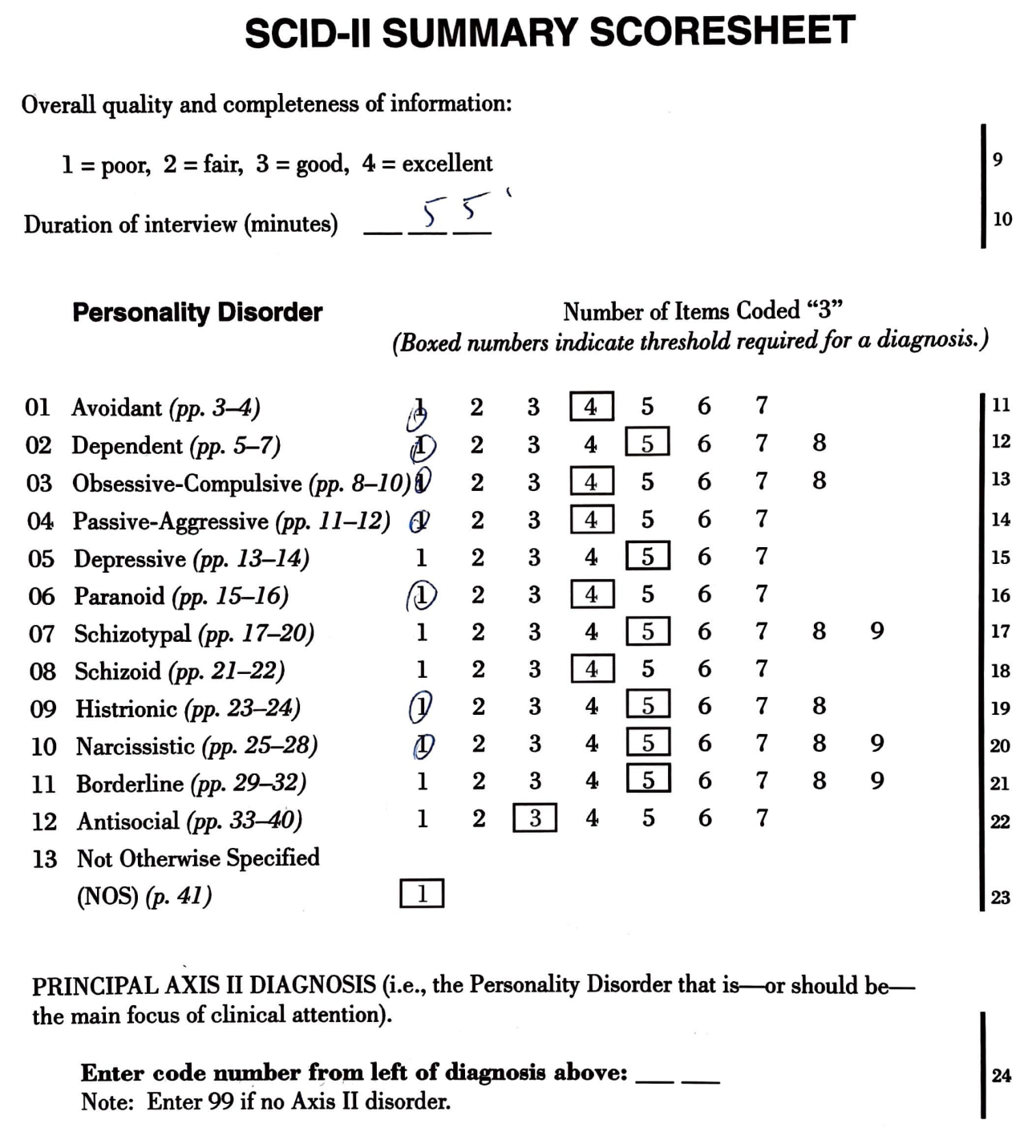
Ready to try to count to two yourself? This file is the SCID-II scoring by Dr. Suffield — Dr. Suffield circled ?, 1, 2, or 3s based on his “clinical judgment”. The actual items were redacted by Dr. Suffield whereas Dr. Suffield’s written notes about Ms. T were redacted by myself in black ink for privacy. In any case, Dr. Suffield circling of ?, 1, 2, or 3 numbers is clearly visible, unredacted, for each question/item/criteria. If you can count to 2, you should arrive to the counts listed in “Reality/Objective Truth” column:
| SCID-II Personality Disorder Assessment | Reality/Objective Truth | Dr. Suffield’s SCID-II Summary Scoresheet |
| 01 Avoidant (pp. 3-4) | 0 | 1 |
| 02 Dependent (pp. 5-7) | 0 | 1 |
| 03 Obsessive-Compulsive (pp. 8-10) | 0 | 1 |
| 04 Passive-Aggressive (pp. 11-12) | 0 | 1 |
| 05 Depressive (pp. 13-14) | No notes/No circles | Nothing circled |
| 06 Paranoid (pp. 15-16) | 0 | 1 |
| 07 Schizotypal (pp. 17-20) | No notes/No circles | Nothing circled |
| 08 Schizoid (pp. 21-22) | No notes/No circles | Nothing circled |
| 09 Histrionic (pp. 23-24) | 0 | 1 |
| 10 Narcissistic (pp. 25-28) | 2 | 1 |
| 11 Borderline (pp. 29-32) | No notes/No circles | Nothing circled |
| 12 Antisocial (pp.33-40) | No notes/No circles | Nothing circled |
| 13 Not Otherwise Specified (NOS) (p. 41) | No notes/No circles | Nothing circled |
Once you finish the counts, you can compare your counts to the numbers Dr. Suffield circled on his SCID-II Summary Scoresheet (see above). If you do, you should conclude, according to the laws of the basic math, specifically the laws of counting zero to two objects, that Dr. Suffield got it wrong seven times out of seven.
We expect clinical psychologists to be 100% accurate, not 100% inaccurate, when scoring psychological tests. In high-stakes assessments, it is simply not acceptable to be accurate only 50% of the time, or even 95% of the time. The only acceptable accuracy rate when counting to 2 is 100%.
However, if we were to be incredibly generous—if we were willing to play Russian roulette with examinees’ lives and expect a psychologist to be only 99% accurate on simple clerical tasks, like counting circled numbers—the probability of making a basic counting error seven times in a row is:
p = (0.01)^7 = 0.00000000000001
That is a 1 in 100 trillion chance.
When a practitioner gets the math wrong seven times in a row on simple counts, they cannot hide behind the excuse of “simple human error” or “clerical slip-ups.” Mathematically, a run of seven consecutive errors is not a random accident. It is statistical proof of either gross, stunning incompetence or deliberate, motivated bias to force the data to fit a predetermined, fabricated narrative—in this case, to make it appear that Ms. T had some features of a wide range of personality disorders.
From Bad Math to Fabricated Testimony
While a 100% error rate on basic counting points to gross professional incompetence or deliberate, motivated bias, what occurred on the witness stand enters the realm of severe misconduct.
Dr. John Braxton Suffield testified under oath that the examinee endorsed “some elements of Antisocial Personality Disorder” even though he never made any such claim in his December 30, 1011 Report. Listening to Dr. Suffield’s direct testimony was absolutely shocking. To understand the sheer malice of this statement, one must look at the unique gravity of the label. If a psychologist mistakenly notes that an examinee has features of Obsessive-Compulsive Personality Disorder, it implies they are rigid or perfectionistic. It is a flaw, but it does not destroy anyone’s life.
But Antisocial Personality Disorder is the clinical designation for psychopathy. To brand a human being with “elements of antisocial personality disorder” is to formally label them as having at least some elements of a chronic liar, manipulative, lacking in empathy, violent, inherently dangerous, and untreatable person. Think of Jeffrey Dahmer, the Milwaukee Cannibal, serial killer and sex offender.
Yet, when Dr. John Braxton Suffield finally disclosed the raw SCID-II records, the unvarnished truth was exposed: Dr. Suffield had never even asked the questions about Antisocial Personality Disorder, and he had circled absolutely nothing on the SCID-II Summary Scoresheet for Antisocial Personality Disorder. As anyone with unimpaired vision can now see for themselves, Dr. Suffield made no notes for Antisocial Personality Disorder assessment portion of the interview on pp. 33-40, made no circles around ?, 1, 2, or 3s, and he also circled nothing at all on SCID-II Summary Scoresheet.
The Antisocial Personality Disorder interview pages (pp. 33-40) were entirely blank. Dr. Suffield’s under oath testimony that Ms. T endorsed “some elements of Antisocial Personality Disorder” during his SCID-II administration was pure fabrication, conscious or subconcious.
The Disclosure Stonewall
Dr. John Braxton Suffield knew exactly what those blank pages contained, which may explains his persistent, decade-long campaign to keep his raw files hidden:
- Hiding the Scope: In his December 30, 2011 report, Dr. Suffield omitted which specific parts of the SCID-II he actually administered, obscuring the true scope of his testing.
- Active Blocking: When an expert review of his clinical file was attempted nearly a decade ago, Dr. Suffield actively barred the copying of computerized records and the summary scoresheet.
- Tactical Delays: When Ms. T applied for an Order to Attend to force the production of these records, SD5 resisted. They argued that Dr. Suffield would be called as an expert witness later and could be cross-examined then—a maneuver the Tribunal accepted, delaying disclosure of the records by several years.
- The Redactions: When finally ordered to disclose in 2025, Dr. Suffield tried one last stalling tactic: he produced heavily redacted files, redacting out both test items and responses. Yet, he simultaneously represented to the Tribunal: “I therefore released the unredacted test responses on April 1, 2025.” (Email to the Tribunal, April 3, 2025).
- The Secret Advocacy: To prevent the unredacted records from coming out, Dr. Suffield went so far as to act as an advocate for SD5 position, contacting other psychologists: Dr. Elisabeth Sherman and Dr. Kyle Brauer Boone. These psychologists subsequently made ex parte, secret submissions to the Tribunal to support Dr. Suffield’s and SD5’s withholding of the records. Ultimately, the Tribunal rejected both Dr. Sherman’s and Dr. Boone’s ex parte secret submissions and forwarded them to the parties.
It took a second, explicit Disclosure Order dated October 14, 2025, to finally force the disclosure of unredacted records.
The unredacted files revealed exactly what Dr. John Braxton Suffield had spent years shielding: the “elements of antisocial personality disorder” he had sworn to under oath simply did not exist in the raw data. There are only a few possible explanations for this stark discrepancy: they were either the result of severe cognitive or memory failures, hallucinations, or deliberate fabrications.
The “Copyright” Defense
For over a decade, Dr. John Braxton Suffield maintained the absurd claim that only another clinical psychologist could view his clinical records. In an email to the Tribunal dated April 3, 2025, he wrote:
“On March 18, 2025, I received an Order from the Tribunal … to forward the Complainant’s responses to psychological tests to her agent [Dr. Bob Uttl], a non-psychologist. In complying with the request, I noted that some of the Complainant’s responses included copyrighted intellectual property of the test publisher. For example, on memory tests, the Complainant’s responses included the protected test materials (e.g., lists of words, figures) themselves.
Such release would not be an issue if the requester was another psychologist, bound by contractual and professional ethical obligations to maintain the security of the test materials. But in this case the Order was to release the material to a non-psychologist, who has no such obligations.”
Dr. John Braxton Suffield, Email to the Tribunal, April 3, 2025
Dr. Suffield appears to be fundamentally unfamiliar with basic principles of copyright law:
- Examinees Own Their Own Minds: Test publishers do not—and cannot—hold copyrights to an examinee’s responses. An examinee’s answers are their own creation, not something the test publisher produced.
- Words and Facts Are Free: Test publishers cannot claim copyright over common words, phrases, or facts. They are fundamentally not copyrightable.
- No “Magic” Retroactive Copyrights: When test publishers adopt publicly available, previously published materials and incorporate them into their tests, they do not magically acquire copyrights to those materials. Nor do those original, public publications magically become “unpublished” secrets. As the saying goes: “There is no point in closing the stable door after the horse has bolted.”
The Pearson Paradox
Dr. John Braxton Suffield also appears to be unfamiliar with a simple fact: registered clinical psychologists are not the only people qualified to view, purchase, score, and interpret psychological tests.
As major test publisher Pearson explains:
“A central principle of professional test use is that individuals should use only those tests for which they have the appropriate training and expertise. Pearson supports this principle by stating qualifications for the use of particular tests, and selling tests to individuals who provide credentials that meet those qualifications.”
Pearson Clinical (https://www.pearsonclinical.ca/en/ordering/how-to-order/qualifications/qualifications-policy.html)
Arguably, a clinical psychologist like Dr. John Braxton Suffield—who seems unable or unwilling to reliably count from 0 to 2—is unqualified to use any psychological test, regardless of his professional registration.
But in any case, Ms. T’s agent, Dr. Bob Uttl, is a Professor of Psychology with over 25 years of experience teaching advanced courses in psychometrics and psychological testing, authored an extensive list of peer-reviewed publications on psychological testing and measurement, and holds a C-Level qualification from Pearson. This is the highest credential tier available, authorizing him to purchase any psychological test Pearson sells.
Looking at the timeline, one is left with a glaring question: Was Dr. Suffield genuinely confused about copyright law, or was he simply using it as a convenient shield? When a practitioner fights for ten years to hide files that are ultimately revealed to contain fabricated findings and elementary counting errors, the conclusion is hard to escape. The only thing his “test security” defense actually protected was himself.
The Final Nail in the Coffin of Dr. Suffield’s Personality Testimony
On the final day of hearings and the climax of his cross-examination on June 19, 2026, Dr. John Braxton Suffield was forced to make a series of stunning concessions. Under oath, Dr. Suffield finally admitted that:
- He did not diagnose Ms. T with any personality disorder (or any mental disorder whatsoever).
- Her personality is completely, perfectly normal.
Here is the cross-examination exchange:
QUESTION: Now you never diagnosed Ms. T with any personality disorder, correct?
DR. JOHN BRAXTON SUFFIELD: Correct. So this was an opportunity for me to falsify or verify some hypotheses that I had developed over my multi-assessor file review. One of those hypotheses is that she has some personality traits, including narcissistic personality disorder, that I thought, you know, possibly could impact her functioning. And through the SCID, I found that she hardly had any traits that were outside her experience as a cheerleader and desire to perform in front of crowds and possibly teach. A very normal and natural kind of personality traits, not a disorder. So the SCID and my interview allowed me to as I say verify or in this case not verify some of my hypotheses that I developed in a preliminary review for October 2011 [i.e, Sufifeld’s October 19, 2011 Report, signed, executed, without ever seeing Ms. T].
QUESTION: And in fact, you did not diagnose Ms. T with any mental disorder, correct?
DR. JOHN BRAXTON SUFFIELD: Correct.
Cross-Examination of Dr. John Braxton Suffield, June 19, 2026
Let the gravity of this admission sink in.
Dr. John Braxton Suffield openly admitted on the witness stand that his actual diagnostic testing revealed “hardly any traits” outside of normal human variation, actively falsifying his own biased clinical claims, the claims he now explicitly downgraded to mere “hypotheses”.
Yet, look at the staggering double standard at play:
- The Written Narrative: His written reports and previous testimony were systematically used to paint a dark picture of clinical pathology—even going so far as to fabricate and to suggest “antisocial features.”
- The Raw Math: The pathologizing features were generated by his own mathematical incompetence—specifically, his inability or unwillingness to accurately count circled 3s and to circle the correct count on the SCID-II scoresheet.
- The Pre-Judgment: He admitted under oath that he went into the assessment with pre-formed “hypotheses” of Narcissistic Personality Disorder based on his “multi-assessor review” rather than approaching the examinee without bias and with scientific objectivity.
When forced to release his unredacted records and forced to look at the objective data on the witness stand, Dr. John Braxton Suffield’s manufactured house of cards collapsed. The expert’s own mouth confirmed what the raw data showed all along: Ms. T’s personality is entirely normal, and the “pathology” existed only in Dr. Suffield’s broken arithmetic and invented, hallucinated, or otherwise conjured “anti-social” features.
Conclusion
In June 2026—nearly 15 years after he signed his December 30, 2011 report and faxed it to School District No. 5 Southeast Kootenay (SD5)—Dr. John Braxton Suffield finally admitted under cross-examination that the highly damaging claims about Ms. T’s personality, including his sworn testimony about “elements of antisocial personality disorder” in 2024, were merely unverified “hypotheses” rather than facts. By his own admission, his administration of the SCID-II on November 30, 2011, did “not verify” these speculations.
Why exactly did Dr. Suffield keep this a secret for 15 years?
Why did he not state clearly in his December 30, 2011 report—written just 30 days after he administered the SCID-II—that his pre-existing hypotheses had been thoroughly falsified, debunked by his own assessment?
For nearly a decade and a half, the raw data behind Dr. Suffield’s “hypotheses” remained hidden from scrutiny. It was only when the Tribunal issued its October 2025 Order to Disclose that Dr. Suffield was finally legally compelled to hand over his records unredacted—demolishing any hope of keeping his scoring sheets, his calculation errors, and his non-assessment of antisocial personality disorder secret.
No Canadian woman—or man, for that matter—should ever be subjected to Dr. Suffield’s “hypotheses” masquerading as facts. No one should lose their livelihood and their career based on speculative theories that the expert himself knew, as of November 30, 2011, were completely unsupported by his own diagnostic data.
No clinical psychologist unable to count to two ought to be able to practice in Alberta, nor in Canada, nor elsewhere. However, the College of Alberta Psychologists presumably reviewed Dr. John Braxton Suffield’s clinical file, including his SCID-II records, and, in dismissing Ms. T’s four complaints against Dr. Suffield, concluded that the ability to count to two is not necessary for Alberta Registered Psychologists conducting high stakes fitness for duty assessments such as Dr. Suffield.