By Dr. Bob Uttl
United States Department of Labor, Manpower Administration, Washington, D.C.
The actual source of the data Dr. John Braxton Suffield misrepresented to the College of Alberta Psychologists as coming from “the Canadian edition of the GATB”
The Claim
In his September 27, 2021 expert report filed with the British Columbia Human Rights Tribunal, Dr. John Braxton Suffield, owner of Dr. J. B. Suffield & Associates, offered a precise, quantified claim about Ms. T’s intellectual fitness to teach:
… The aptitude figures for elementary school teachers (NOC 4142) originated with 497 seniors in university education programs who participated in the initial and cross validation for this group. The data are in Table 9-3 of Section III (page 170) of the manual for the General Aptitude Test Battery (GATB)…
Ms. T’s score of 83 in Dr. Westcott’s 2010 assessment was more than 2 standard deviations below this average, at approximately the 0.9 percentile [emphasis added] of this sample of nearly 500 prospective teachers.
Dr. John Braxton Suffield, Sep. 27, 2021 Expert Report, pp. 13-14
The 0.9th percentile is a dramatic figure — it tells a tribunal that, among prospective teachers, all but roughly one in a hundred score higher than Ms. T did. It is precise, it is quantified, and it is presented as a scientific fact grounded in the aptitude norms of the very test Ms. T was administered: the GATB CDN, the Canadian edition.
It is none of those things.
What Dr. Suffield Already Knew, a Year Before He Ever Heard of Ms. T
Dr. John Braxton Suffield‘s April 2010 email correspondence goes further than establishing that the Career Handbook’s occupational levels lack empirical grounding. In the same email exchange — a year before School District No. 5 first contacted him about Ms. T — Dr. Suffield was told directly, by Nelson Education (the GATB’s Canadian distributor) and by Human Resources Development Canada (HRDC, the test’s developer), several things relevant to what he would later submit to the Tribunal and to his own regulator.
First, that the U.S. GATB had fallen out of use in its own country because of documented racial bias. On cross-examination, Dr. Suffield confirmed his own April 2010 email showed he knew this at the time:
QUESTION: According to this email, you were aware that USES GATB was no longer widely used in the U.S., correct?
DR. JOHN BRAXTON SUFFIELD: Correct.
QUESTION: And you knew that it came, quote, “under fire from the U.S. Justice Department because of cultural bias issues,” unquote, correct?
DR. JOHN BRAXTON SUFFIELD: Yes…
QUESTION: Did you understand at the time that the cultural bias issues [referred] to the fact that… Black test takers scored substantially lower than White test takers and thus were deemed ineligible for jobs at much higher rates than Whites?
DR. JOHN BRAXTON SUFFIELD: Yes, that was part of the concern. I believe there were some civil rights actions in the U.S. based on those findings or allegations.
Cross-examination of Dr. John Braxton Suffield
Second, that no Canadian equivalent of the U.S. occupational data — the section containing tables like Table 9-3 — has ever existed. The correspondence itself, read into the record, shows Nelson’s own contact telling Dr. Suffield in April 2010: “Unfortunately, my files do not include the Canadian edition of Section 4.”
Asked directly whether anyone has ever established occupation-specific empirical norms of this kind for the Canadian GATB, Dr. Suffield’s answer under oath was unqualified:
QUESTION: Have you ever seen any occupational norms of the sort which we looked at [in the] U.S., conducted by administering the GATB [in Canada]?
DR. JOHN BRAXTON SUFFIELD: No.
Cross-examination of Dr. John Braxton Suffield
By his own account, then, Dr. John Braxton Suffield knew — from April 2010 onward, before he had ever heard of Ms. T — that the instrument whose occupational validation data he would later cite to a human rights tribunal and to his own professional college had a documented history of racial bias serious enough to draw U.S. Justice Department scrutiny, and that no Canadian equivalent of that occupational data has ever existed for him, or anyone, to see. Dr. Suffield did not disclose any of these facts in his 2021 expert report or in his 2021 letter to the College of Alberta Psychologists. Instead, Dr. John Braxton Suffield knowingly mislead the College of Alberta Psychologists and wrote in his response to Ms. T complaint against him that the Table 9-3 was from “the Canadian edition” of the GATB.
Where the Table 9-3 Actually Comes From
Ms. T’s complaint to the College of Alberta Psychologists followed directly from this report. She alleged, among other things, that Dr. John Braxton Suffield had relied on and failed to criticize the claim that the GATB “permits comparison of client characteristics with those of actual workers in specific occupations” — a claim he had personally been told, by the test’s own publisher, was unsupported and clearly false. In his written response to the College, Dr. Suffield defended his use of Table 9-3 — the same table underlying the 0.9th-percentile figure in his Tribunal report — describing it — falsely — as coming from “Sections III and IV of the Canadian edition of the GATB.”
On June 2026 cross-examination, shown the actual source document (Exhibit CB228), Dr. John Braxton Suffield was asked to confirm what it was:
QUESTION: It prominently states here, United States Department of Labor, Manpower Administration, Washington, D.C. Would you agree with me that this is the manual for the [U.S.] General Aptitude Test Battery, which you copied Table 9-3 from?
DR. JOHN BRAXTON SUFFIELD: Yes, I believe if we turn to page 170 in this manual, we’ll find that table.
QUESTION: That’s where you copied your table from, correct?
DR. JOHN BRAXTON SUFFIELD: Correct.
Cross-examination of Dr. John Braxton Suffield
There is no Canadian edition source for Table 9-3. Dr. John Braxton Suffield claim to the College of Alberta Psychologists that Table 9-3 came from “the Canadian edition of the GATB” was patently false, intentional disinformation. Dr. Suffield knew no such data existed for GATB CDN.
As Dr. John Braxton Suffield finally admitted under oath and penalty of perjury, Table 9-3 comes from a U.S. Department of Labor manual and not the Canadian GATB manual, the data were gathered using U.S. GATB and not GATB CDN, the data were based on US sample and not Canadian Sample; and the data were about 60 or 70 years obsolete at the time he used them.
Why the Distinction Isn’t Academic
Ms. T was tested on the GATB CDN (Nelson, 1986), normed in 1985 for the Canadian population. The U.S. GATB is a different instrument, with different norms, developed and normed decades earlier. Dr. Suffield’s own report to the Tribunal draws the comparison as though the two are interchangeable — computing Ms. T’s percentile against a sample that was never part of the test she took.
Worse, this was not an available substitute for missing Canadian data offered in good faith. Dr. John Braxton Suffield had specific, personal, prior knowledge — dating to correspondence with the GATB’s publisher in April 2010, and reconfirmed in further correspondence in 2014 — that neither the GATB CDN’s occupational levels nor the Career Handbook data used to interpret them were empirically derived from any tested sample, Canadian or otherwise. On cross-examination, he described the actual process behind the Canadian occupational levels published in the Career Handbook as a panel of raters assigning categorical judgments — “simply categorical readings” — not measurements of real workers. No Canadian equivalent of a 497-teacher validation study exists, and Dr. Suffield knew it did not exist, at the time he offered Table 9-3 as though it filled that gap.
What the U.S. Table Actually Contains
Even considered strictly on its own terms — as 1950s American data, correctly labeled — Table 9-3’s underlying norms do not withstand scrutiny. On cross-examination, walked through the source USES GATB manual page by page, Dr. John Braxton Suffield confirmed:
- The general working population norms behind the USES GATB manual were established in 1952, from a sample of roughly 4,000 people with an average age of 38 and average education of 10.9 years — meaning, on average, the reference sample had not completed high school.
- The sample excluded farm laborers, farm managers, foremen, proprietors, managers, officials, and all service workers — reducing the eligible 1940 census population of 45 million by roughly half.
- Of the entire ~4,000-person sample, only 52 were women in professional or semi-professional occupations.
Asked directly whether this data was representative of the working population, or of the U.S. population as a whole, Dr. Suffield agreed it was not: “I think that’s a fair statement.”
None of this context — the 1950s origin, the small and skewed professional-female subsample, the systematic occupational exclusions — appears anywhere in Dr. Suffield’s 2021 report to the Tribunal or his 2021 letter to the College of Alberta Psychologists. Both present the 497-teacher figure and the resulting percentile calculation without qualification, as though it were current, representative, and for the GATB CDN actually administered to Ms. T.
The Retreat
Confronted on cross-examination with the absence of any of this context in his report, Dr. John Braxton Suffield attempted to distance himself from the very table he had submitted:
QUESTION: And you did not mention that those were 1950s in your report, correct?
DR. JOHN BRAXTON SUFFIELD: Well, no, my report was focused on the Canadian GATB that was administered to Ms. T, and the reference norms for that were the Canadian norms.
QUESTION: Well, you pulled Table 9-3 from this manual [USES GATB Manual]. And you did not mention anything about this type of stuff, correct?
DR. JOHN BRAXTON SUFFIELD: That’s correct.
Cross-examination of Dr. John Braxton Suffield
The defense collapses on contact with reality, with Dr. John Braxton Suffield‘s own conduct. If his report was, as he now says, “focused on the Canadian GATB” and Canadian norms, there was no basis to introduce Table 9-3 — 1950s U.S. Department of Labor data — into either his report to the Tribunal or his defense to the College of Alberta Psychologists in the first place.
What the Table 9-3 Was Used For
This was not a peripheral citation raised only in Dr. John Braxton Suffield‘s own defence. It was the evidentiary core of the claim he put before the Tribunal itself: the specific, quantified figure — 0.9th percentile — that gave his opinion its most scientific-sounding support. Only after Ms. T identified the problem and filed her complaint did Dr. Suffield defend the table to his regulator, this time falsely describing its source as Canadian.
The College of Alberta Psychologists‘ Deputy Registrar and Complaints Director, Dr. Troy Janzen, accepted Dr. Suffield’s false defense and cited the same table as central to dismissing Ms. T’s complaint:
He [Dr. John Braxton Suffield] was able to provide specific references from the test manual that supported his interpretation… This included an excerpt from the GATB Manual (p.170) which clearly indicates that a sample of both elementary and secondary teachers were included and there was available data for comparison to your results… I am inclined to agree and feel that the offered critiques of the language use do not rise to a level to constitute unprofessional conduct.
Dr. Troy Janzen, Deputy Registrar and Complaints Director, College of Alberta Psychologists
The regulator’s dismissal of the very complaint about this table rested, in material part, on Dr. John Braxton Suffield‘s description of its source — a description he has since confirmed, under oath, was false. The table that had already done its work before the Tribunal — producing the 0.9th-percentile figure, sixty years and a border removed from the woman it was said to describe — went on to do a second job: shielding the psychologist who used it from professional consequence, based on a citation that did not withstand cross-examination.
The Admission That Undoes Dr. Suffield’s Percentile Claim
Later in the same cross-examination, Dr. John Braxton Suffield was taken to another table in the same U.S. manual, CB228: Table 17-12, showing 1968 mean aptitude scores by racial group among test-takers in California. Dr. Suffield confirmed each figure, including a mean G score of 84.3 for Black test-takers, against 101.8 for non-minority test-takers in the same sample.
Questioning then returned to Dr. Suffield’s own December 30, 2011 report, and his own figure depicting the G score he had determined was “important for success” for elementary school teachers: approximately 122, derived from the Career Handbook’s Delphi-based rating plus one standard error of measurement and some stunning, previously undisclosed alchemy and data manipulation. The arithmetic consequence of applying that standard to the U.S. data just reviewed was put to him directly: a mean score of 84.3 sits nearly two standard deviations below a threshold of 122 — meaning almost no one in that historical sample would meet the standard Dr. Suffield had set for fitness to teach.
Dr. Suffield did not defend the 122 threshold. He objected to the comparison itself:
DR. JOHN BRAXTON SUFFIELD: Here we’re looking at Canadian norms. This does not figure into the Canadian general working population…
QUESTION: So I guess what you’re saying is that people in a different country from a different era would score differently on this test?
DR. JOHN BRAXTON SUFFIELD: Absolutely… It’s depicting the performance of a Caucasian woman in Canada compared to other performers in Canada.
QUESTION: So if I hear you correctly, it is inappropriate to compare how people in the 1960s scored on USES GATB to these Canadian norms or Canadian values important for success, correct?
DR. JOHN BRAXTON SUFFIELD: Correct.
Cross-examination of Dr. John Braxton Suffield
Next, Dr. Suffield was taken to his 0.9th percentile based on his comparison of Ms. T’s GATB CDN scores to USES GATB Table 9-3 historical data from US:
QUESTION: So, right here, we are comparing Ms. T’s score on GATB Canadian edition in 2010 to some historical data [USES GATB Table 9.3]. So, we are comparing the historical scores on USES GATB from a different era and a different country, correct?
DR. JOHN BRAXTON SUFFIELD: That is correct. And that is overly precise. And I would phrase that differently now…
QUESTION: Well, you put this graph in and you made this comparison of two incomparable things, which you just testified were inappropriate to compare.
DR. JOHN BRAXTON SUFFIELD: That’s correct. And as I said, that’s an overstatement.
Cross-examination of Dr. John Braxton Suffield
The 0.9th percentile figure Dr. John Braxton Suffield gave to the BC Human Rights Tribunal to describe Ms. T’s occupational fitness — precise to a tenth of a percentile point — is, in his own words, “an overstatement,” produced by comparing “two incomparable things.”
Asked when he first learned Table 9-3 came from the U.S. manual, Dr. John Braxton Suffield said he could not recall. Whatever the truth of that answer, it does not change what the record and Dr. Suffield’s under oath admission reveal: By April 2010 — a year before he had ever heard of Ms. T — Dr. Suffield had been told directly that no Canadian equivalent of the Table 9-3 occupational data has ever existed, and had separately learned that the U.S. instrument — USES GATB — the data came from had fallen out of use in its own country over documented racial bias serious enough to draw U.S. Justice Department scrutiny.
Of course, as PhD educated U.S. born citizen, Dr. John Braxton Suffield is presumed to have sufficient cognitive capacity to understand that the GATB manual published in “1970” and bearing the publisher’s name as “United States Department of Labor, Manpower Administration, Washington, D.C.” was not the Canadian manual for GATB CDN (Nelson, 1986) in any case.
The first page of the USES GATB manual is copied below:
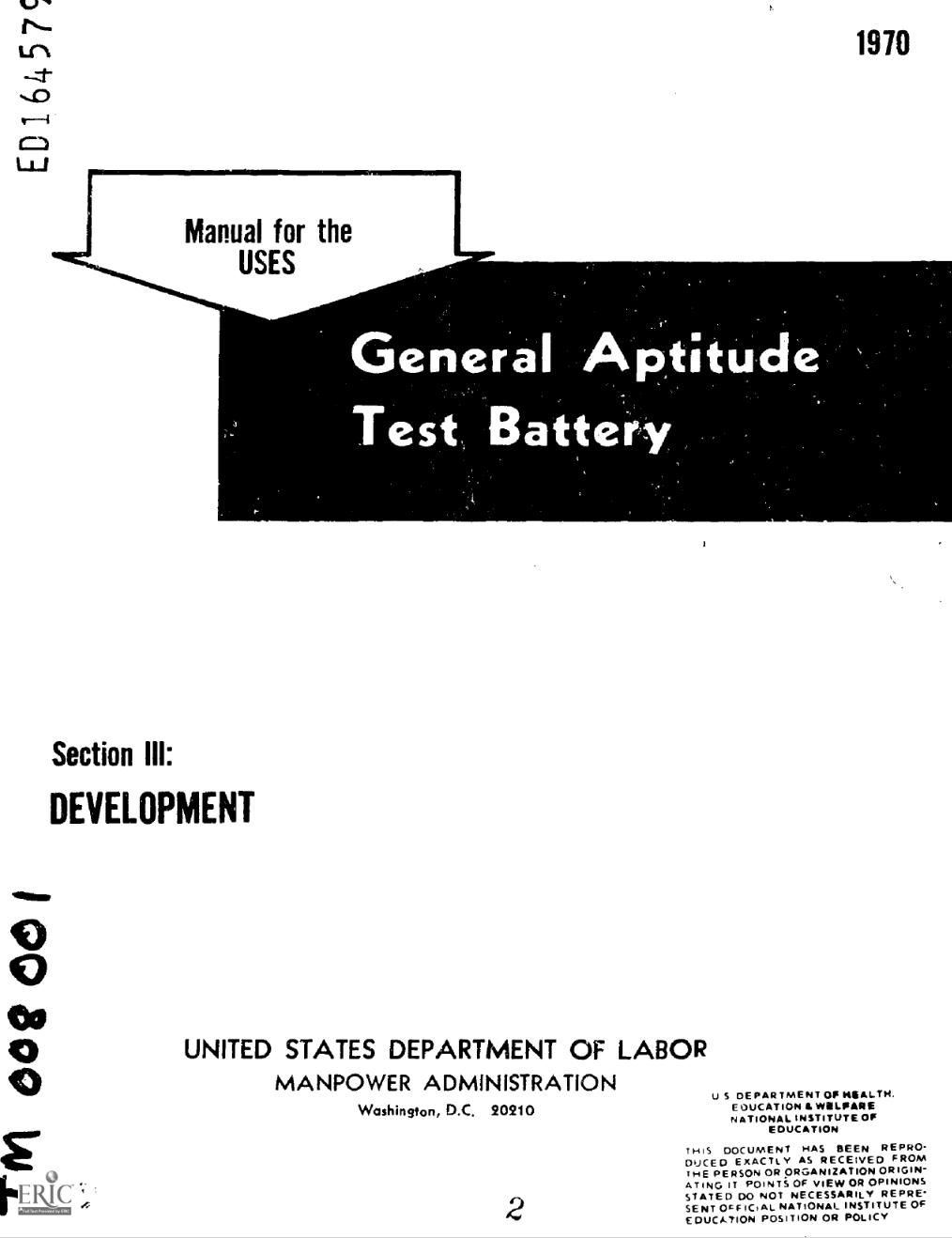
The 5th grader ought to be able to tell from this page that it is USES GATB manual published in U.S. more than a decade before the GATB CDN manual was published by Nelson in 1986.
If you click on either of the two links below, you will be able to see and download the USES GATB Section III Manual published in 1970 by the Department of Labor, Washington, D.C., USA, in its entirety:
On page 170 of this manual, you will find the Table 9-3 from this USES GATB manual copied by Dr. John Braxton Suffield into his expert report dated September 28, 2021 and relevant parts available here.
The Stunning Regulatory Failure
The ultimate failure of this case extends beyond a single expert witness relying on obsolete, cross-border data and misrepresenting it as Canadian. It rests squarely with the regulatory body whose statutory duty is to safeguard the public interest and maintain the integrity of the profession.
When Ms. T brought these issues to the College of Alberta Psychologists, the regulatory system failed to perform basic factual verification. Deputy Registrar and Complaints Director Dr. Troy Janzen, alongside the Complaints Review Committee—including Dr. Lorraine Breault and Dr. Ali Al-Asadi—accepted Dr. John Braxton Suffield’s written assertion that Table 9-3 was drawn from the “Canadian edition” at face value.
This is what Dr. John Braxton Suffield wrote to the College of Alberta Psychologists on May 24, 2021, five years before he finally admitted the facts under oath:
Third, Ms. T also alleges that I lacked competence when I “failed to criticize” Dr. Westcott’s “patently false statement” that an examinee’s GATB scores can be compared to those of actual workers in specific occupations. She further alleges that I then knew that no such comparisons were possible because, “no one actually administered GATB [GATB CDN] to any such actual workers in Ms. T’s occupation,” and that Nelson Canada [GATB CDN publisher] had told me so.
This is incorrect, and disingenuous. As detailed in Sections III and IV of the Canadian edition of the GATB [emphasis added], many occupations – including elementary and secondary school teachers – were studied extensively when the GATB was developed. Table 9-3 (below) shows data from the 234 elementary and secondary school teachers who participated in an initial validation, and another 263 teachers who participated in a cross-validation study. Thus, GATB scores for teachers are based on a total sample
of 497 teachers.Ms. T’s agent, Dr. Uttl, was aware that GATB norms are available for many specific occupations, because I sent him some of my email correspondence with Nelson Canada in March 2017.
Therefore, Ms. T and Dr. Uttl were aware that Dr. Westcott was essentially correct when she wrote: “The GATB does what very few other tests do: it permits comparison of client characteristics with those of actual workers in specific occupations.” While it would have been more accurate for her to write that “the GATB permits comparison of client characteristics with those of actual workers in some specific occupations,” she was not wrong in this case, because teachers are part of the GATB specific occupations database.
[Table 9-3 from USES GATB, p. 170, inserted here]
Dr. John Braxton Suffield’s Response to Ms. T’s Complaint, May 24, 2021
The College of Alberta Psychologists was told unequivocally that Dr. Suffield’s claim of the “Section III and IV of the Canadian edition of the GATB” was false, that no such occupational data existed for the GATB CDN, and that Dr. Suffield fabricated the claim and compared incomparables. The College was also provided with the direct link to the USES GATB Manual from which Dr. Suffield had copied Table 9-3.
Dr. Lorraine Breault and Dr. Ali Al-Asadi only had to point and click to determine whether Table 9-3 came from Canadian or USES GATB Manual. In fact, Dr. Breault, Dr. Al-Asadi, and the Complaints Review Committee had the evidence in their hands before they rendered their decision: Appeal of Dr. Troy Janzen’s dismissal of complaints against Dr. J. Braxton Suffield (Excerpt) (Two relevant stories posted before Dr. Suffield’s admissions are: The CAP Complaints Review Committee Did Not Read the Submissions… and How many licenced psychologists does it take to locate a correct test manual?)
By accepting a patently false claim without independent verification, and ignoring detailed evidence before them, the College of Alberta Psychologists did not merely dismiss a valid complaint; it actively relied on a fabricated claim to shield an expert witness from professional accountability. When professional regulators rubber-stamp invalid psychometric data rather than audit them, they erode public trust in both the legal system and the field of psychology.
While the Health Professions Act provides no statutory mechanism for the College of Alberta Psychologists to reopen a dismissed complaint file, this administrative debacle demands direct accountability. Given their failure to perform basic due diligence under the Act, Dr. Troy Janzen, and Complaints Review Committee members, including Dr. Lorraine Breault and Dr. Ali Al-Asadi, should resign from their positions and recuse themselves from adjudicating future complaints. The public cannot be protected if those tasked with oversight are unwilling—or unable—to detect when a regulator is being misled, especially when verifying the truth required nothing more than clicking the provided link and scrolling to Table 9-3.